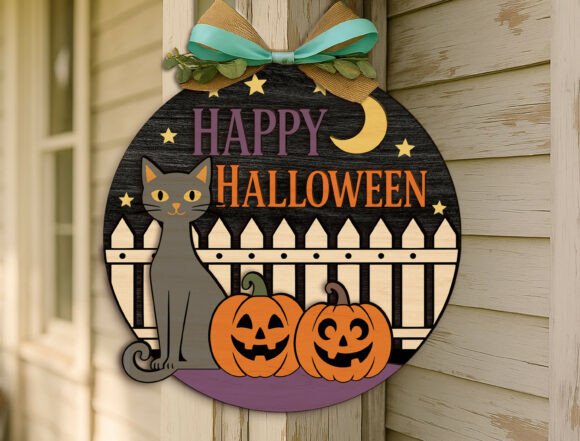
Happy Halloween Black Cute Cat Door Sign
A Designer’s First Glance: Charm with Quiet Confidence
When I opened the Happy Halloween Black Cute Cat Door Sign files, what struck me wasn’t just cuteness—it was intention. The silhouette is clean and centered, with a soft curve to the cat’s back and a subtle tilt to its head that reads as playful, not cutesy-overload. It’s black-on-black in spirit—minimalist enough for modern boutiques, but warm enough for handmade baby blankets or cozy kitchen towels. As an embroidery designer who’s stitched hundreds of seasonal motifs, I immediately saw where this would shine: on structured fabrics with gentle texture, like medium-weight cotton twill, linen-blend tea towels, or brushed poly sweatshirts. It doesn’t scream “Halloween”—it whispers it, with wit.
Where This Design Truly Belongs (and Where It Doesn’t)
I tested the Happy Halloween Black Cute Cat Door Sign as a machine embroidery design on a custom embroidered tote bag for a local bakery’s October pop-up. Paired with off-white canvas and matte black thread, it landed perfectly—clear, legible at 4.5 inches wide, and balanced without overwhelming the fabric. It also worked beautifully as a small embroidered patch on a denim apron, stitched with satin stitch outlining and light fill stitch for the ears and face. That said, I’d avoid using it directly on highly stretchy fabrics like jersey knits or thin baby rib without significant digitizing adjustments—it lacks interior detail anchors for stabilizer hold, and the smooth curves can blur if tension isn’t dialed in just right.
This design excels in projects where simplicity reads as sophistication: holiday gift tags stitched onto muslin pouches, nursery wall hangings on felt-backed cotton, or even as a sublimation-ready motif on ceramic mugs (thanks to the included PNG and SVG files). Because it’s part of the Autumn Amp collection—and labeled Laser Cutting—I double-checked the vector paths. They’re smooth, closed, and well-spaced—ideal for clean laser-cut wood signs or acrylic door hangers. But remember: as a digital embroidery file, it’s not pre-digitized. You’ll need to convert or commission digitization for stitch execution.
Real-World Embroidery Considerations
Stitch density matters here. The original outline is elegant, but when translated into a fill-stitch version for a pillow cover, I noticed slight crowding around the cat’s tail tip and inner ear curve. On dark fabric, that area risked looking muddy unless I reduced stitch count or added a subtle running stitch border for definition. For baby embroidery or personalized gifts, I recommend stitching it in matte black thread on ivory organic cotton—soft contrast, zero glare, and high tactile appeal.
It’s not ideal for curved surfaces like caps without repositioning and hoop adaptation. The shape is too wide and flat for standard front-cap placement without distortion. Likewise, tiny lettering isn’t present (there’s no text in the design), which is actually a strength—it keeps focus on the cat and makes scaling flexible. But if you plan to add your shop name or “2024” beneath it, leave ample vertical breathing room when positioning.
What Makes This Work for Small Businesses & Etsy Sellers
- Brand consistency: Its quiet tone fits seamlessly into cohesive autumn collections—think matching tea towel + oven mitt + embroidered patch sets.
- Giftability: Customers respond well to designs that feel personal but not overly literal. This cat isn’t wearing a witch hat or holding candy—it’s just *there*, calmly festive. That subtlety elevates perceived value.
- Commercial flexibility: Since it’s delivered as SVG and PNG, it supports multiple workflows—embroidery digitizing, sublimation, vinyl cutting, and printable mockups for your Etsy listings. Just confirm licensing terms before bundling it into a digital embroidery bundle or selling finished items at scale.
Practical Designer Notes Before You Stitch
Before committing to a client project or shop batch, do these five things:
- Test on scrap fabric first—especially if using textured weaves or dark backgrounds. See how the black thread interacts with your base color.
- Review stitch density in your embroidery software. If filling large areas, consider reducing density by 10–15% for breathability on apparel.
- Confirm hoop size compatibility. At full width (approx. 5–6 inches), it fits standard 5x7 hoops—but verify your own machine’s limits.
- Inspect small details in both black-and-white and grayscale mockups. What looks crisp on screen may soften after stitching.
- Use tear-away + light cut-away stabilizer combo for medium-weight fabrics; switch to fusible mesh for knits or lightweight linens.
Final Thought: A Thoughtful Addition, Not a Trend Chaser
The Happy Halloween Black Cute Cat Door Sign won’t dominate your holiday catalog—but it might become your most-requested small-batch item. It’s the kind of design that feels handmade even when mass-produced, because its restraint invites interpretation. A craft fair shopper picks it for her daughter’s backpack; an Etsy seller uses it to anchor a “Spooky Season” collection; a café embroiders it onto staff aprons and gets tagged in three Instagram stories in one weekend. That’s the quiet power of smart, scalable design.
If you're evaluating this as a machine embroidery design, applique design, or digital embroidery file for your craft business—trust your eye, test deliberately, and let the cat do the talking. It’s got presence. You just need to give it the right fabric, thread, and context to land.