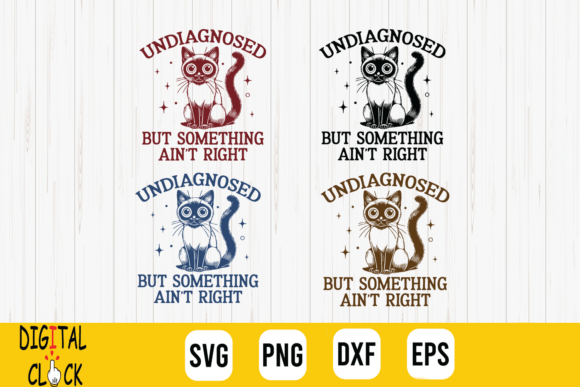
Vintage Cat Animal Saying Cat Meme Qoute
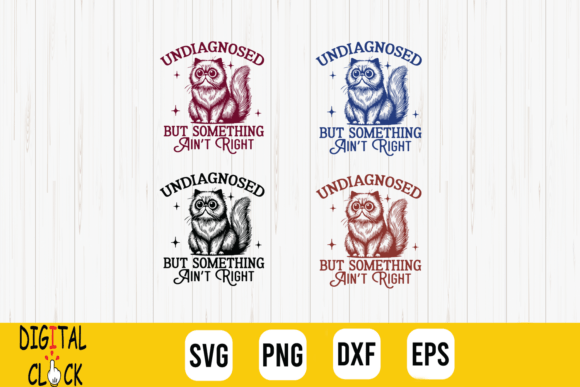
Let’s be real: I’ve stitched hundreds of cat-themed designs—some charming, some cloying, most forgettable. So when Vintage Cat Animal Saying Cat Meme Qoute landed in my inbox with its dry, slightly exasperated tagline—“Undiagnosed But Something Ain’t Right”—I paused. Not because it’s flashy, but because it *feels* like something a real person would actually wear, stitch, or gift. As a designer who tests embroidery files before recommending them to clients or listing them in my own shop, I ran this one through a full project simulation: a custom embroidered canvas tote for a local cat café’s holiday pop-up.
A Design That Breathes Like a Real Cat (Not a Stock Illustration)
The first thing that stands out is its intentional restraint. This isn’t a busy, layered meme collage—it’s a clean, centered phrase with subtle vintage typography and a minimalist cat silhouette tucked beside the text. No gradients, no drop shadows, no over-rendered fur. Just confident line work and smart negative space. That simplicity is gold for embroidery: fewer tiny jumps, less thread buildup, and far better legibility at 3–4 inches wide—the sweet spot for tote bags, aprons, and pillow covers.
It reads instantly. “Undiagnosed But Something Ain’t Right” lands with wry warmth—not sarcasm, not irony, but the kind of gentle self-awareness cat lovers recognize in themselves (and their pets). That tone translates beautifully into handmade products: it feels personal, not mass-produced. A customer buying a baby onesie with this design isn’t just buying cuteness—they’re buying shared language.
Where It Shines—and Where It Needs Careful Handling
In real-world embroidery, Vintage Cat Animal Saying Cat Meme Qoute excels on medium-weight, stable fabrics: canvas totes, cotton sweatshirts, tea towels, and denim jackets. On a 10-oz canvas tote, the lettering held crisp edges with standard poly thread and medium-cutaway stabilizer. The cat icon—a compact, stylized profile—stitched cleanly as a satin-stitched outline with minimal fill, avoiding density issues common in dense applique designs.
But here’s where attention matters: the lowercase “a” in “Ain’t” and the apostrophe are small. On stretchy fabric (like a lightweight jersey tee) or tightly woven dark garments, those details can blur without proper hooping tension and stabilizer backing. I’d avoid placing it on curved surfaces like baseball caps unless you’re using a cap frame and reducing stitch density manually. Likewise, for baby embroidery—think onesies or burp cloths—test the backside for scratchiness; tight satin stitches near necklines need soft underlay or a light tear-away.
It also performs well across product types that rely on visual clarity over texture: embroidered patches (great for iron-on or sew-on applications), pillow covers (where the phrase reads from across the room), and kitchen towels (where humor meets utility). For holiday embroidery—say, a linen stocking or felt ornament—the vintage font gives it timeless charm, not seasonal clutter.
What It Does for Your Craft Business (Beyond Just Looking Cute)
If you’re an Etsy seller or small shop owner, Vintage Cat Animal Saying Cat Meme Qoute works hard for brand consistency. It’s distinctive enough to stand out in a sea of paw prints and “Crazy Cat Lady” clichés, yet versatile enough to pair with neutral palettes—charcoal gray thread on oatmeal linen, navy on cream cotton, or even metallic silver on black canvas. That flexibility means fewer mockup variations needed for your listings, and stronger cohesion across your digital embroidery file bundles.
More importantly, it builds trust. Customers scanning your shop for “funny cat embroidery” aren’t looking for generic clip art. They’re looking for wit, authenticity, and craftsmanship. This design delivers both—if you stitch it thoughtfully. A poorly stabilized version on a thin t-shirt will look muddy and cheap; a well-executed version on a heavyweight sweatshirt says, “This was made by someone who cares about how it feels *and* how it reads.” That perception lifts perceived value, repeat purchases, and word-of-mouth referrals.
Practical Designer Notes Before You Stitch
- Always test on scrap fabric first—especially if pairing with textured weaves (like burlap or terry cloth) or dark backgrounds.
- Check thread color contrast in natural light. Light gray thread on heather charcoal can disappear; off-white on oatmeal pops softly.
- Review stitch density in your embroidery software. If the file includes heavy fill in the cat shape or thick lettering, reduce density slightly for breathability on apparel.
- Confirm hoop size compatibility. This design fits comfortably in a 4×4 hoop, but double-check the actual dimensions in your software—some versions may extend slightly for balanced spacing.
- Inspect small details like the apostrophe and fine serifs. Zoom in. If they’re under 1mm tall post-stitch, consider simplifying or omitting them for small-format items (e.g., baby caps).
- Test black-and-white mockups before finalizing listings. Humor relies on readability—and grayscale reveals where contrast fails.
- Use proper stabilizer: medium cutaway for knits, tear-away for stable wovens, and fusible for lightweight linens.
- Verify licensing before selling finished products or bundling the file commercially. Since the description lists SVG, PNG, EPS, and DXF formats, confirm whether commercial use is permitted for all formats—not just the embroidery file.
Final Thought: It’s Not Just a Design—It’s a Conversation Starter
I stitched Vintage Cat Animal Saying Cat Meme Qoute onto a cream-colored linen pillow cover for a boutique launch last month. Within two days, three customers asked, “Is that from your own collection?” Not because it looked custom-drawn—but because it *felt* intentional, human, and quietly clever. That’s the mark of a strong machine embroidery design: it doesn’t shout. It invites a smile, a nod, a shared glance between cat people. Whether you’re building a craft business, personalizing gifts, or expanding your digital design assets, this one earns its place—not as filler, but as a thoughtful, stitch-ready piece of personality.